
Scene stills

Hi there my friends!
Here you go with the next Anime review, Garden of Words!
Here, per usual, the PDF with the images and formatting: zmote.deviantart.com/art/Revie… (https://zmote.deviantart.com/art/Review-Garden-of-Words-a-review-by-zmote-419941465)
And here the the text only version:
Hello’s and Welcome’s
first!
I greet you, dear reader and lover of Anime! How are you feeling this fine *insert daytime*? Me? I feel awesome! Much due to another opportunity to write another Anime Review! Once more it will be a blast to write you about another Anime Movie, this time the movie being “Garden of Words.”
Plot overview and
Mature Content Watch
The story revolves around the 15 year old student Takao Akizuki, who dreams about becoming a shoe-maker and the young woman Yukari Yukino, who is going through some life troubles. They both meet on a rainy morning in a park for the first time and their relationship evolves from there on.
Visually there isn’t anything really obscene. Clothing can be described as generally western, springtime style, which isn’t as revealing as summer clothing, and in my honest opinion, pretty much harmless.
Story-wise I could say that this is an improper relationship from an islamic point of view, especially in the later scenes at the apartment of Yukari Yukino, where they cook meal and eat together. Although nothing serious happens; from an islamic point of view, two “namahrem” people aren’t allowed to be alone in a room, so it might encourage something wrong for Muslims. That being said, you should be generally on the watch when watching Japanese Anime anyways, so scenes like that shouldn’t really be a bother if you know to differentiate and enjoy it as entertainment only.
Furthermore I’d have to mention Yukino drinking beer while she is in the park, which might encourage wrong behaviours, especially for younger audiences.
Plot Summary and Personal Thoughts
Ok, finally arriving at the interesting part! Yay! Fair warning though, spoilers are ahead.
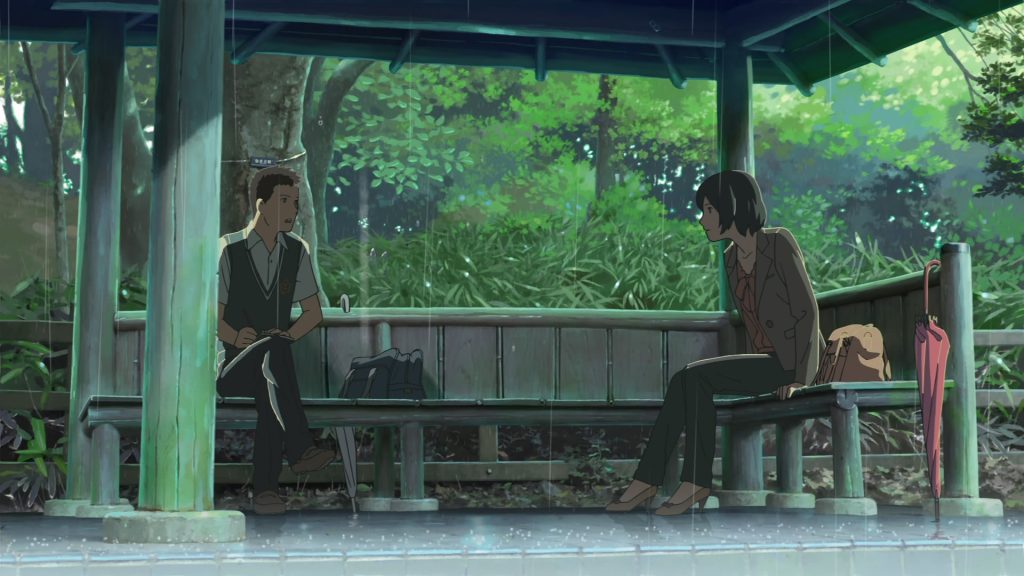
Garden of Words starts with some beautiful park shots, almost photorealistic and pans over the landscape, introducing us to the epicentre of the plot, namely the lone park cabin with seats for multiple persons to sit on. But don’t imagine too much, the area of the cabin is at most four to five meters square.
Takao Akizuki, as mentioned in the plot overview, dreams to become a shoe-maker. Thus he decides that every rainy morning, come school or not, he’ll venture into the park and work on his drafting skills.
In his first morning session, he spots some young woman already seated in the park cabin he intends to work. He approaches the cabin, greets her politely and takes a seat on the opposite side. But soon he is distracted by that same young woman, named Yukari Yukino, as she is drinking cans of beer with chocolate. This odd combination of nutrition grabs Takao’s attention and they start to talk. After having noticed Takao’s school crest, Yukari leaves with a sort of a poem called a “tanka”, which leaves Takao back puzzled.
Takao comes drafting new designs for shoes in the park whenever it rains. And as it is springtime, he is quite often there, too. To his surprise, Yukari seems to be there almost always when he is there as well. So over time they get to know about one another more and more.
At one point Takao tells her about his dream, and that he thinks that he still needs to exercise a lot more. On another morning, he admits that if he could make a shoe for someone it would help him a lot. Upon which Yukari offers her feet, which Takao gladly accepts. When taking measures of her feet, Yukari indicates towards some deep personal troubles by saying: “I need to learn to walk on my own two feet; that is why I come here often.” On a yet other encounter, Yukari gives Takao a present, namely a pricy book about shoe-making. Takao starts to work on his dream harder than ever, spending every free time on drafting shoe designs and working on the actual shoes for Yukari.
As the season of springtime slowly changes towards summer, the rainy days become more and more rare and Yukari doesn’t get to see Takao for a long while.
One day though, Takao figures out the solution to the tanka Yukari mentioned on their first encounter. The solution suggests that she’ll be in the park even when it doesn’t rain, so he meets her with the solution on a sunny day in the park. There finally Takao learns the identity of Yukari Yukino; she is a literature teacher at his school.
This revelation doesn’t change much in their relationship, and after it suddenly starts to rain and thunder, they run to Yukari’s apartment, their clothes all soaked in water. They spend an afternoon together in her apartment, drying their clothes off and preparing meal together. In this moment, both realize that they haven’t been ever happier than now, and Takao admits that he might be falling in love with Yukari. Though she blushes at his remark, she says the he ought to address her as “Miss Yukari” or sensei. She continues to reveal that she is returning to her home town and thanks Takao for having been there in this troubled time of hers.
Confused by her rejection, Takao leaves abruptly the apartment. When Yukari is left alone in her apartment, she starts to cry and realizes her mistake, and runs after Takao.
She finds him some floors below. Takao still angry and hurt shouts that he regrets having ever opened up to her, that she will always live alone and that she should tell him that his dreams are worthless. That’s when Yukari runs towards Takao and into his embrace, and they both start to cry together.
In the epilogue it is revealed that they live apart. Takao has failed his exams and Yukari has moved to another town and is happy at her current school. Takao returns to the park and lays down two finished pairs of shoes with a letter for Yukari.
Finally, he says that he’ll come after her when he is able to take “bigger” steps, probably referring to his failed exam and him still working his part-time job.
And that’s how it ends.
Although quite sweet story how it seems, I’m still puzzled why a teacher would involve herself with a student, especially a high-school student. Don’t get me wrong, but if you’re honest to yourself, you all know that high-school time generally ranges from the ages 15 – 20, which is full on puberty time.
Ok admittedly, nothing really happens, no kiss or similar interactions, but the love relationship is strongly suggested. I guess it’s a relief to know that they live apart and Yukari might involve herself with someone worth her time. No offense to Takao, but dude, hit the twenties and focus on school first, before ruining your life with a serious relationship you can’t handle. I mean I felt somewhat sorry for him that he was still stuck on that teacher in the epilogue.
Well, I guess you can’t interfere with such things, can you? Every culture has almost the same saying about this phenomenon, don’t they? Love makes blind, so, so blind. Muhahaha!
And that’s it for this review. There isn’t much I want to add in terms of personal thought stuff, as the story did take on a fairly limited subject range. Ok, maybe not quite true, but definitely the first thing that strikes you about the story is its superficial side. It’s quite straight-forward, doesn’t try to tell you something big and important that might have an influence on your way of thinking. It doesn’t make you reflect really, it’s just a somewhat dramatic story. I mean the intriguing character here was Yukari Yukino, but you didn’t get to know what exactly put her in her current position and why. It’s hinted that it has to do with some senior students, but the subject has been very superficially touched to that extent that I thought it wasn’t worth dwelling too much on it.
But of course if you’d ask me how the movie holds up in terms of contextual references and story-telling elements, it’s another story. Aside the boring superficial part, there are interesting topics one could dwell and write about. For example the symbol of rain in comparison to both characters current situations, and the cabin as a place of refugee and insouciance. Quite exciting to talk about stuff like that, but it’s not the place in a review.
So sorry for another quite lengthy or somewhat long review, but that’s just me.
Once more I enjoyed thoroughly writing this review for you guys out there and am thrilled about writing the next one! Suggestions are always welcome!
With best regards,
Zmote,
Zmote.deviantart.com
PS: I’m looking through some more “academically” approached reviews and I really like how they are done. But it’s a little problematic doing something like this in a review, as these are meant to increase your appetite for the show/movie and not discuss metaphors, story-telling elements and total revelation of the entire story.
If you’re interested in more in-depth looks into Anime shows/movies like that, let me know and I might start a new series in my profile if there is sufficient request.
Here a taste for something in that direction from another writer: nopybot.com/2013/06/04/observa… (https://www.deviantart.com/users/outgoing?http://nopybot.com/2013/06/04/observations-in-the-garden-of-words-an-explanation-of-shoes-rain-and-love/)
See you around at the next one!
zmote
Originally published by Anime4Muslims on DeviantArt. Source: https://www.deviantart.com/anime4muslims/journal/Garden-of-Words-a-review-by-zmote-419941958. Original contributor: zmote.